Just What Is Harmless Error?

You don’t need to be a very experienced trial lawyer, nor a particularly wise judge to understand that there is rarely a perfect trial. Mistakes or errors occur, so the harmless error doctrine should come as no surprise to anyone.  Harmless error is based upon a finding that the error was not significantly prejudicial to the appellant so as to affect the outcome of the case.

Many appellate court opinions set forth a two-step analysis: first, determining if there was indeed error; and second, determining if such error was harmless. The whole process is however not quite as simple as it may seem. Too often lawyers and judges only remember the harmless holding and forget error occurred and at least in future cases it should not occur again.  In Vasquez v. United States (SCOTUSblog case page here), The United States Supreme Court will decide  the meaning and application of the federal harmless error rules.  The SCOTUSblog has a quick  read  oral argument preview in this post:

Vasquez v. United States [concerns] the meaning of the harmless error rule in Federal Rule of Criminal Procedure 52(a) and 28 U.S.C. § 2111. These similarly worded provisions govern appellate review of any trial error to which counsel objected below; they provide that if an error does not affect “substantial rights,” then it was harmless, and an appellate court should not reverse to correct it.  The proper scope of the harmless error rule has divided the courts of appeals.  Many hold that unless the government proves that the error could not have had any material effect on the proceedings below, it cannot be harmless. Others hold errors harmless when the evidence of the defendant’s guilt is overwhelming. Because the harmless error rule governs so many cases, its meaning is one of the most important questions in criminal appellate law….

It will be interesting to see whether the Court regards the harmless error rule as primarily concerned with process, or instead with results.  Vasquez argues that the Seventh Circuit erred because it failed to consider how close the case was, and failed as well to analyze the effect of the error on the overall verdict.  But if the Seventh Circuit had gone through the motions of such an analysis and reached the same conclusion, it is not clear what else Vasquez would say the court was required to do.  The rules set forth by the United States, on the other hand, are more concerned with the outcome of the analysis.

Another interesting question is whether the Court will treat the error in this case as serious or not. Vasquez argues that the error was global — i.e., that because the tapes suggested that even his attorney didn’t believe in his defense, they tainted the jury’s consideration of the case as a whole.  Respondent argues that the error was minor — the tapes would have been admitted anyway, and the court’s only error was failure to provide a limiting instruction. Both characterizations have some force to them.

.

Social Media & the Law Update Update

Two updates on social media and the law. One is very practical. A link to an abstract of a Duke Law Review article on juries and social media: http://papers.ssrn.com/sol3/papers.cfm?abstract_id=2020499

 Although the other is at best quirky, it is interesting. Among the most widely read (or at least interesting legal blogs) is the Volokh conspiracy. Professor Volokh had an interesting post recently about social media and a now former Assistant United States Attorney entitled: Criminal Defendant Outs Anonymous Web Site Commenter — Who Turns Out to Be One of the Prosecutors

 Eugene Volokh • March 20, 2012 10:40 am

Ars Technica reports; the New Orleans Times-Picayune reports that the prosecutor is being investigated by the Justice Department for possible violations of Justice Department policies. An excerpt from Ars Technica (read the whole thing, which also includes many links):

A federal investigation involving New Orleans landfill magnate Fred Heebe took a surprising turn this week. Heebe filed a court petition claiming a frequent commenter on local-news site NOLA.com was in fact Sal Parricone, one of the prosecutors assigned to his case. Heebe turned out to be right.

The commenter took regular shots at Heebe and his family, seeming to know more about the case than an average reader of the site might….

So Heebe hired a former FBI forensic linguist, James R. Fitzgerald, to analyze 598 comments made over the course of 6 months by a commenter using the handle “Henry L. Mencken1951.″ Fitzgerald, who also worked on the arrest and prosecution of Unabomber Ted Kaczynski, compared the comments made by “Mencken1951″ to the language in a 9-page proceeding filed by three Assistant U.S. Attorneys, including Parricone, against the CEO of Heebe’s company, River Birch Landfill. The language was strikingly similar. Given that Parricone was born in 1951, Heebe singled him out in the court petition. On Thursday afternoon, U.S. Attorney Jim Letten confirmed Perricone had used the “Henry L. Mencken1951″ handle.

Does Apprendi Apply to Criminal Fines?

If there is a “sleeper” blockbuster case that the United States Supreme Court might decide this term it could be whether Apprendi applies to criminal fines.

This AP report on the oral argument in Southern Union, the Apprendi fines case, reported that “several justices sounded skeptical of the government’s case for upholding the penalty against Texas-based Southern Union Co. over its improper storage of mercury in a building in Pawtucket.”  In part, the story said:

Unlike other Supreme Court disputes involving corporations, this case does not appear to divide the justices along ideological lines. In the sentencing cases, conservative Justice Antonin Scalia has been the most forceful advocate for reining in judges and requiring juries to find any facts that could lead to a longer sentence.

Scalia said he sees the Southern Union case as a logical extension of the court’s earlier rulings. He said it would be odd to require a jury to establish facts that lead to even the shortest jail term, yet give judges freedom to decide on fines that “will make a pauper of you.”

But another conservative justice, Samuel Alito, seemed more open to the administration’s argument. Alito, a former prosecutor, has been more supportive of the government’s side in sentencing cases.

Oral arguments can, at times, be misleading, but the argument in this case is  posted here at the Supreme Court’s official website


Is Life Without the possibility of Parole Unconstitutional When Applied to Juveniles?

Juveniles can commit horrendous crimes, but when does the Constitution require that the law take into account the age of the defendant when it comes to life sentences? The answer will come this term based on two cases argued before the United State Supreme Court.  There are about 80 prisoners nationwide serving life without the possibility of parole sentences for murders committed at age 14 or younger. Estimates are that there are as many as 2,300 prisoners nationwide serving sentences of life in prison without parole for murder committed under the age of 18.

The Court is wary of life without parole for juveniles: Mark Sherman of The Associated Press has this report. Sherman says, “The precise contours of an eventual ruling were not apparent after arguments Tuesday, but several justices said they were troubled by the way some states try and sentence young people accused of crimes. Justice Antonin Scalia expressed concern that the Court would be substituting its judgment for that of state legislators. “I’m supposed to impose my judgment on what seems to be a consensus of the American people?” he asked.

James Vicini of Reuters reports that “Supreme Court weighs if teen murderers must get chance of parole.” Vincini’s observation of the argument included this assessment of three of the justices, Justice Anthony Kennedy, a moderate conservative who cast the decisive vote in the earlier rulings, expressed concern that trial judges have no discretion in states with mandatory sentences, “What’s a judge supposed to do?” he asked.  Justice Elena Kagan asked whether individual factors, such as an offender’s age, should be taken into account in sentencing juveniles to life in prison without parole, a scheme that would be similar to what has been used for adults in death penalty cases.

For a look at the briefs as well as a recap of the argument visit the scotusblog.com. There, Lyle Denniston has a post titled “Argument recap: Compromise on youth sentences?

When Does (If Ever) A Defendant Open the Door?

Application of the exclusionary rule is often times complicated for a trial judge.  While the vast majority of prosecutors accept (even if begrudgingly) a court ruling excluding evidence, there are some who chafe at the word excluded and persist in trying to get the evidence admitted somehow. More often than not that somehow theory is premised on an argument that the defendant “opened the door.” There is a timely and interesting new law review article on that agument. Kainen on Opening the Door to Illegally Obtained Evidence

 James L. Kainen (Fordham University – School of Law) has posted Shields, Swords, and the Moral Autonomy of Jurors on SSRN. Here is the abstract:

Using ideas rooted in fact-finding accuracy, courts hold that defendants open the door to illegally-obtained evidence when they use exclusion as a “sword” to offer contradicted evidence or arguments. Yet the metaphor holding that rules excluding evidence can function “as shield, but not a sword” is inapt when applied to rules that promote non fact-finding goals. Whether the door is opened to admission of evidence excluded by such rules must depend on a contextual analysis of the rule’s purpose. Finding that defendants cannot use the constitutional exclusionary rule to advance contradicted evidence or argument negates its necessary deterrent function. Defendants should lose immunity against illegally-obtained evidence only when they offer evidence derived from the same unlawful search or interrogation, or ask the jury to consider why the prosecution did not produce the suppressed evidence. The waiver rule allows the exclusionary rule to accomplish its purpose while protecting the integrity of our fact-finding process, which occasionally values social goals above fact-finding accuracy. By distinguishing arguments about the absence of suppressed evidence from those equivalent to assertions by witnesses required to lie about events to prevent jurors from learning of suppressed evidence, the waiver rule protects jurors from the assault on rational autonomy to which Kant objected. Whether Kant would find sufficient evidence law’s respect for jurors’ right not to be lied to or insist upon their right to all available evidence, we cannot expect evidence rules to function without limiting the evidence that jurors consider. As long as we do, courts must assure that their decisions about opening the door do not undermine the goals that exclusion is designed to achieve.

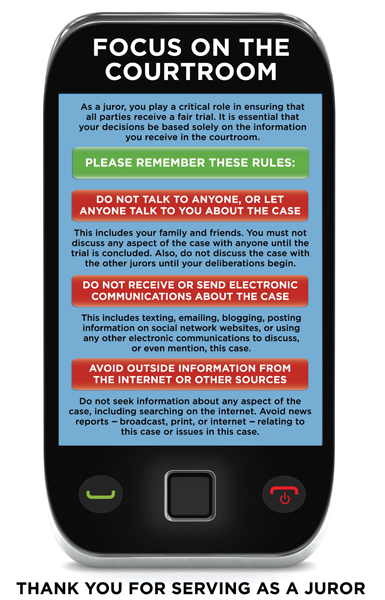
Focus on the Courtroom

 Washington Courts Displaying “Focus on the Courtroom” Poster in Deliberation Rooms

Twitter, Facebook, and other social media make judges, lawyers, and court administration very nervous when it comes to jurors. While we can’t blame Bill Gates and Microsoft for the problem, we can credit the Washington judiciary for a unique way to combat the problem.    Check out  the  poster being displayed by Washington Courts to focus jurors on their duties.
http://www.courts.wa.gov/newsinfo/content/juryRoomPoster.jpg

US Senate Judiciary Committe Votes Cameras in the Supreme Court: Don’t Count On It Happening Soon

The Senate Judiciary Committee recently voted, 11-7, for legislation that would open Supreme Court arguments to television coverage. Prospects that anyone will be watching Supreme Court arguments on television in the near future are however pretty bleak. Most Republicans on the Judiciary Committee voted no. There is no serious effort in the House of Representatives. Last Friday the Supreme Court turned down a request from C-Span to televise the arguments soon to occur on the health care legislation. 

In November, C-SPAN asked the Supreme Court to open its doors to TV cameras — and millions of viewers — for the marathon health care oral arguments that are scheduled March 26-28.  “We believe the public interest is best served by live television coverage of this particular oral argument,”  Brian P. Lamb, C-SPAN’s chief executive, wrote to Chief Justice John G. Roberts Jr. “It is a case which will affect every American’s life, our economy and will certainly be an issue in the upcoming presidential campaign.” C-SPAN was joined in its request by other news organizations.

On Friday, an Associated Press article said, “The justices have never allowed cameras inside the courtroom and decided not to make an exception for the health care case, despite what the court called ‘extraordinary public interest.’”  But there are opponents from quarters that one might not expect. For example, according to a Washington Post opinion, the U.S. Supreme Court should not allow TV cameras in the courtroom. Live coverage of the court proceedings would cause the “solemn” proceedings to deteriorate, the opinion says.

Video of the Judiciary Committee session is available here, via C-SPAN.


Court Funding Issues: A View from Kansas by Judge James F. Vano

Several years ago, a prominent Senator from my home district spoke to the Kansas Judicial Conference about recent legislation. One of the first things he said was that the Judicial Branch budget was going to have trouble in the future, that the court system was going to have to find its own solutions to pay its own way, and that we would have to look more to “user fees” in the future to generate revenue for the courts. My first thought was, “Whoa!  Where did he go to law school anyway?” I could not tell whether he was buying into that mantra of “user pay,” or if he was simply the bearer of bad news. But, that is the fight was seem to have today. There is a fundamental misunderstanding of our constitutional and historical function that is turning the courts into another revenue making agency, as though we were selling state privileges, like hunting licenses or permits to cut hair.

During the years between college and law school, I worked for the New York State Education Department. Frequently, during breaks and over the lunch hour, you could find me in the State Law Library browsing or checking out the works of Joseph Story, Carl Llewellyn, and Oliver Wendell Holmes, Jr. One of the treatises I read cover to cover was Prosser on Torts – long before going to law school. Law and government, the concepts of ordered liberty, excited me. Those writers and others sold me on the significance of the independent judiciary in government. Studying the tripartite form of government seen throughout the United States, I was moved to start my journey to become a part of the Judicial Branch. I was not about making new laws or setting new policies, but about assuring stability and continuity in the principles by which our free society could continue to function. I pinch myself every day realizing that doors beyond my ability or power to move were opened to put me in the place to do the job that I so passionately am dedicated to perform.

The Judicial Branch, the court system, does not serve merely the litigants before the court in a particular case. The Judicial Branch, contrary to those who want to politicize the courts with chants of “judicial activism” and other slurs, is all about predictability and stability under law.  The courts, as every other branch of government, are bound by the constitutional principle of equal protection under the law. We live by the concepts of stare decisis. If that were not so, there would be no reason for funding our law schools or for studying law. Lawyers study law and court decisions in order to advise their clients about likely outcomes so that clients and businesses can govern their own conduct accordingly in order to avoid problems. Courts interpret and apply the law, not merely for the benefit of the litigants, but for all of the community. That independent governmental function insures freedom and protection of rights. It lends predictability and stability to our society.

The court should not be funded by user fees beyond a nominal filing fee. Access to justice should not be limited by mounting costs and surcharges to get in the door. Court records, likewise, should be open, free and accessible to all.  Let’s not allow politics and political posturing to close the courthouse doors or in any manner limit access to justice under law or charge anyone to review, study, to question, criticize, or rely upon the court’s decisions. Out of varied facts of the individual cases litigated, we serve to govern all. Judicial Branch funding is and always should be a general fund obligation. Funding requires revenue. Revenue-raising is taxation. Taxation is political. And, the political, revenue-raising Branch of government is and should remain the Legislature.

It is incumbent upon the bench and bar, as officers of the court, to reinvigorate our professional calling and then re-educate ourselves on the historical and constitutional significance of the independent, yet fully funded, Judicial Branch of government. Then, we must carry that message to the public and to our legislators. We cannot reverse this tide that would undermine our balanced government if we do not stand against the mantra of “user pay” the accusations of “judicial activism” and the efforts across the country to politicize the judiciary.

The plurality of American society needs a fully funded, free and independent judiciary in order for this constitutional republic to survive.

James F. Vano, District Judge, Division 2, Johnson County Courthouse, Olathe, KS  66061, (913) 715-3760, FAX (913) 715-3769

New York Times Go to Trial: Crash the Justice System

There are judicial critics of plea bargaining. Some judges will participate and help parties settle criminal cases, and others don’t. But if you look at the numbers, the criminal justice system might grind quickly to a halt if there were not some degree of plea bargaining. And so the opinion piece recently published by the New York Times entitled Go to Trial: Crash the System is a short but provocative read.   

From The New York Times:  OPINION: Go to Trial: Crash the Justice System

 What would happen if thousands of people charged with crimes refused to plead out?

http://nyti.ms/AwxB1l


More from Morrison: Facebook and the Fifth Amendment

Caren Myers Morrison (Georgia State University – College of Law) has posted Passwords, Profiles, and the Privilege Against Self-Incrimination: Facebook and the Fifth Amendment (Arkansas Law Review, Forthcoming) on SSRN.  Here is the abstract: 

While Facebook has become ubiquitous in most people’s lives, it is also making increasingly frequent appearances in criminal cases. In the past few years, Facebook has emerged as a fertile source of incriminating information from boastful or careless defendants who find in Facebook a great way to project their outlaw persona to the world.

But does the Fifth Amendment privilege against self-incrimination shield someone who has posted incriminating information on his Facebook page from being forced to disclose his password or provide access to his profile?

Continue reading “Morrison on Facebook and the Fifth Amendment “