The American Judges Association: Making Better Judges

There are four new resources from the National Center for State Courts on implicit bias. The resources include a report of three pilot educational programs on implicit bias and shorter excerpts from the large report that can be used as stand-alone pieces for presentations, judicial education programs, committee meeting discussions, and so forth. Specifically, the four resources include:

 1. Helping Courts Address Implicit Bias: Resources for Education describes and evaluates pilot judicial education programs on implicit bias in three states and offers lessons learned. It also includes appendices with resource materials for programs on implicit bias.

2. Addressing Implicit Bias in the Courtsbriefly describes the implicit bias phenomenon and outlines potential strategies that court professionals can use to combat implicit bias.

3.  Implicit Bias: Frequently Asked QuestionsQuestions addresses some common questions about implicit bias and what contemporary science tells us about this cognitive phenomenon.

4. Strategies to Reduce the Influence of Implicit Bias identifies conditions that may give rise to implicitly biased judgment or behavior and details seven general approaches to address implicit bias in the courts based on current scientific research.

Research shows that individuals develop implicit attitudes and stereotypes as a routine process of sorting and categorizing the vast amounts of sensory information they encounter on an ongoing basis. Implicit, as opposed to explicit, attitudes and stereotypes operate automatically, without awareness, intent, or conscious control and can operate even in individuals who express low explicit bias. Because implicit biases are automatic, they can influence or bias decisions and behaviors, both positively and negatively, without an individual’s awareness. The new resources are provided to help courts raise awareness of implicit bias and potential strategies to address it.


All of the resources are available on the National Center for State Court’s  web site at http://www.ncsconline.org/D_Research/ref/implicit.html  


Who Has the Right to Decide Whether or Not to Release Autopsy Photographs?

 Ninth Circuit Finds Substantive Due Process Right to “Control Public Dissemination of a Family Member’s Death Images”

Who “owns” the rights to the sometimes gruesome photographs of murder and crime scenes? The opinion in Marsh v. County of San Diego by Chief Judge Kozinski and joined by Judges Paez and Wardlaw involves a claim by a mother that her Due Process rights were violated when a prosecutor investigating the death of her 2-year old son copied autopsy photographs of her son and then disclosed one of the photos to a newspaper. “Given the viral nature of the Internet,” the court concludes, the effort to publish the autopsy photo was an “intrusion into the grief of a mother over her dead son” that shocks the conscience and therefore violates the mother’s right to substantive due process.”   The U.S. Court of Appeals for the Ninth Circuit was first reported  by Howard Bashman in How Appealing.

Important Event: Turner v. Rogers Anniversary Forum

Turner v. Rogers Anniversary Forum:

 Fundamental Fairness and the Ability to Pay in Child Support Proceedings

June 20, 2012 from 2:00 – 3:30 pm


You are invited to a forum sponsored by the Office of Child Support Enforcement (OCSE) and the Department of Justice’s Access to Justice Initiative.  Please join a panel of experts on June 20, 2012, for a discussion of the critical messages from Turner v. Rogers.  One year ago, the United States Supreme Court decided Turner v. Rogers, which required states in civil contempt proceedings to provide procedures that ensure a fundamentally fair determination of whether an unrepresented parent is able to comply with a court order to pay child support.  The forum will include a discussion of setting realistic child support orders, and other promising practices that avoid the build-up of arrears; explore cost-effective strategies for child support compliance, including alternatives to contempt, and, discuss expanding self-help services and access to justice for unrepresented litigants.  The forum will also highlight OCSE policy guidance arising out of Turner.

Participants will learn about concrete tools to transform child support contempt practice and to assist litigants without lawyers.  They will also learn about how Turner applies in the child support context as well as the country’s civil courtrooms, in light of the increasing numbers of self-represented litigants. 

Confirmed speakers include George Sheldon, Acting Assistant Secretary Administration for Children and Families; Vicki Turetsky, OCSE Commissioner; Daniel Olmos, Department of Justice Access to Justice Initiative Senior Counsel; Alan Houseman, Center for Law and Social Policy Executive Director; Richard Zorza, Self-Represented Litigation Network; Diane Potts, Illinois Deputy Attorney General; and, Pamela Lowry, Administrator of the Division of Child Support Enforcement for Illinois.

This event will be webcast at www.hhs.gov/live. There will be limited seating for the event in the HHS Auditorium, 200 Independence Avenue, S.W., Washington, DC.    To register for this event, please go tohttp://events.constantcontact.com/register/event?llr=vt7m85dab&oeidk=a07e5xnwsuk54634bab


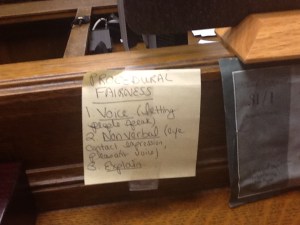
Thoughts from Roger Hanson on Listening and Procedural Fairness

Roger Hanson sees a logical connection between the attributes behind good listeners in the context of a hearing and how the ingredient for listening ultimately lead to procedural fairness.  He wrote the following:

Focus

Structure

Purpose

Knowing the purpose of a hearing

Knowing how a hearing should proceed

Knowing that a hearing has definite outcomes

Increases

Ability to achieve

Efficiency

And

Minimize dilatory behavior

Increases

Ability to achieve Concentration

And

Emphasize attorney preparation

Increases

Ability to achieve

Attentiveness

And

Avoid routineness

           I’ll assume efficiency, concentration, and attentiveness allow judges to listen and then speak in an authoritative manner indicating an understanding of the issues, and relevant particular circumstances. If so, doesn’t that type of behavior resemble procedural fairness?

Don’t litigants and lawyers believe that when judges allow others to speak and then respond directly and tell litigants and lawyers the basis for their decision, and do so by recognizing the particular circumstances in a case, there is an element of procedural fairness (voice, neutrality, respect, and trustworthiness)?

Focus, structure, and purpose speed up the legal process in orderly manner and recognize the importance of each case.  I get to this conclusion via a hypothetical syllogism (e.g., If focus then efficiency, and if efficiency then orderliness, Hence, if focus, then a judge is an a stronger position to control the process and schedule, arrange, and conduct hearings in an visible way.

If the syllogism is valid, then there is a need only to focus on focus, structure, and purpose. The benefit of that situation is of course, focus, structure and purpose are sufficiently tangible that they can be encouraged, taught and evaluated. Perhaps actually teaching listening requires too much individual attention and hence is labor intensive. However, focus, structure, and purpose in a sense supersede listenships and allow us to deal just with the more tangible.

So I say all of of this in my own of looking at the issue of procedural fairness and what are the ingredients to get judges acting in a way that delivers procedural justice.

You might find my argument and style irritating or unnerving, but I hope you see some small value in it.


Roger A. Hanson is an Adjunct Professor of Law and Political Science at the University of Colorado. He presently serves as a consultant to the National Center for State Courts. He is a prolific writer about justice system improvement.

Profiles in Courage: The Iowa Justices

As first reported in Gavel Grab: 

Three former Iowa Supreme Court justices, removed from the court by voters incensed over a same-sex marriage ruling, talked candidly at an awards ceremony about some of the stresses in store for jurists who make unpopular decisions.

“We were called activist judges — elitist, out of touch with the will of the people — and frankly, a lot worse,” said former Justice David Baker, according to a Des Moines Register article. But he would not have changed his vote even had he known what would follow, he said.

Former Justice Michael Streit said he received an angry letter from a Korean War veteran who fumed that “Hitler treated queers the way they should be treated — in the gas chamber,” and who declared, “You are bastards.”

Former Chief Justice Marsha Ternus said, “Efforts to intimidate the judiciary and turn judges into theologians or politicians in robes” do not advance justice.

The three were presented Profile in Courage awards by the John F. Kennedy Library Foundation in Boston. They took part in a unanimous court ruling that permitted same-sex marriage in Iowa, then the trio faced a backlash in 2010 retention elections. Out-of-state interest groups played a major role in funding the ouster drive.

Bob Vander Plaats, a conservative leader in the forefront of the ouster drive, said further such campaigns are made more likely by the awards this week. “I think this kind of far-left award … only incites that,” Vander Plaats said. In November, Justice David Wiggins will be up for a retention election. 

The American Judges Association mid year symposium was fortunate enough to have Justice Streit as one of the featured presentors. With all due respect to Mr Vander Plaats, the Profiles in Courage award is hardly just some kind of left wing award. After listeing to Justice Streit a better description is these justices received the award not because of ideology, but because they did what they thought was right, they tried their best to explain why they thought the Iowa Constitution compelled the result, and they stand by their principles to this day. That is what judicial courage is about.

Thinking About Sentencing and the Role of a Judge

As first reported in the Sentencing Law & Policy blog there is a  new Sidebar column by Adam Liptak in the New York Times.

Sentencing, regardless of whether you are a limited jurisdiction judge, a general jurisdiction judge, Canadian, or US, is not easy. Compassion is part of it. Proportionality is surely important. More than a few restless nights are part of the life of a thoughtful judge. In the end, what to do with or to a defendant is not always clear……and perhaps maybe that is necessary in order to keep judges focused on doing what is right.  The Liptak piece in part says :

Judge John Gleeson hears cases where he used to prosecute them, in the federal courthouse in Brooklyn. There, in 1992, he led the team of prosecutors that put the Mafia boss John J. Gotti in prison for life. Judge Gleeson is not shy about meting out tough sentences.  “Most people, including me,” he wrote in a 2010 decision, “agree that the kingpins, masterminds and midlevel managers of drug trafficking enterprises deserve severe punishment.”

But he has lately been saying that his old employer, the Department of Justice, has stopped living up to its name when it comes to some small-time criminals.  Almost 20 years to the day after delivering his closing argument in the Gotti trial, Judge Gleeson considered the fate of Jamel Dossie, whom he called “a young, small-time, street-level drug dealer’s assistant.”

Mr. Dossie was an intermediary in four hand-to-hand crack sales, for which he made a total of about $140.  Two of the sales exceeded, barely, the 28-gram threshold that allows prosecutors to call for a mandatory five-year sentence.  “Just as baseball is a game of inches,” Judge Gleeson wrote, “our drug-offense mandatory minimum provisions create a deadly serious game of grams.”

It is a curious game, one in which a participant rather than the supposed umpire can have the last word, Judge William G. Young of Federal District Court in Boston wrote in a ruling in another case a couple of weeks ago.  “Prosecutors run our federal justice system today,” Judge Young wrote.  “Judges play a subordinate role — necessary yes, but subordinate nonetheless.  Defense counsel take what they can get.”

The prosecutors’ decision to invoke the law calling for a mandatory sentence in Mr. Dossie’s case meant that Judge Gleeson had no choice but to send Mr. Dossie away for five years. Had his hands not been tied, Judge Gleeson wrote, “there is no way I would have sentenced” Mr. Dossie to so long a sentence.  “We had a ‘sentencing proceeding’ that involved no written submissions, no oral advocacy and no judging,” he wrote. “The proceeding had all the solemnity of a driver’s license renewal and took a small fraction of the time.”

The Dossiecase illustrates what some judges say is a common problem: Prosecutors’ insistence on mandatory minimum sentences for minor players in the drug trade has warped the criminal justice system and robbed judges of sentencing authority…. As for Mr. Dossie, the judge wrote, “no one could reasonably characterize him as a leader or manager of anything, let alone of a drug business.”

Judge Gleeson called on Attorney General Eric H. Holder Jr. to implement a new policy at the Department of Justice. “D.O.J. should seek mandatory minimum sentences,” the judge wrote, “only in the cases for which Congress intended them: in cases against leaders and managers of drug enterprises, not the low-level offenders like Dossie who constitute the bulk of the federal drug docket.”

About 74 percent of defendants charged with crimes involving crack cocaine faced a mandatory minimum sentence in the year that ended in September, according to statistics compiled by the United States Sentencing Commission.  But only 5 percent of them led or managed a drug business.

A Justice Department spokeswoman said the administration supported the judicious use of mandatory minimum sentencing laws for some serious crimes.  In a 2010 report, Lanny A. Breuer, an assistant attorney general, said mandatory minimum sentences “remove dangerous offenders from society, ensure just punishment and are an essential tool in gaining cooperation from members of violent street gangs and drug distribution networks.”

Paul G. Cassell, a former federal judge who is now a law professor at the University of Utah, said Judge Gleeson’s proposal to have the Justice Department limit its use of mandatory minimum sentences in drug cases to defendants who played a leadership role was “a brilliant package.”  It was, he said, administrable, fair and “doable in this political environment” because it requires no action from Congress.

Jamel Dossie, meanwhile, is serving what Judge Gleeson called an onerous and disproportionate sentence.  “The only reason for the five-year sentence imposed on Dossie,” Judge Gleeson wrote, “is that the law invoked by the prosecutor required it. It was not a just sentence.”

Proposed New Cuts to California Court Budget

The American Bar Association has been pretty relentless in advocating adequate and stable funding for courts. Although many courts have been horribly hit with budget reductions, there are court systems that think the movement to cut budgets has bottomed out. There are even courts that are cautiously optimistic that some modest budget increases might be achievable. None of that is happening in California.  

Chief Justice: New Cuts To State Court Funding “Devastating”

by Bay City News

 California Chief Justice Cantil-Sakauye said today that Gov. Brown’s planned additional cuts of $544 million in state court funding in the next fiscal year “are both devastating and disheartening.”

“They will seriously compromise the public’s access to their courts and our ability to provide equal access to justice throughout the state,” Cantil-Sakauye said in a statement issued in San Francisco.

Jon Streeter, a San Francisco lawyer who is president of the California State Bar, called the cuts “unsustainable.”

“All courts are going to feel the pain, even those that have managed well so far,” Streeter said. For the complete article see:

http://sfappeal.com/news/2012/05/chief-justice-new-cuts-to-state-court-funding-devastating.php.  

 The fiscal problems of California as a state have been widely reported. In a sense, California is a state with few good fiscal options. But at least for the time being, legislators are listening to California court leaders.  A California Senate panel decided Tuesday to postpone a vote on two key measures proposed as part of Gov. Jerry Brown’s revised budget to restructure trial court funding by setting up a statewide reserve and to halt court construction projects, after officials warned that the cuts would devastate the judicial branch.

Planning a Delegation of AJA Members to Travel to Cuba

The American Judges Association is organizing a delegation to visit Cuba for the purpose of researching the country’s legal system.  I am honored to have been selected to lead this delegation and invite you to join us in this unique opportunity. 

If you are interested, please see this link for more information:  http://aja.ncsc.dni.us/pdfs/American_Judges_Association_Invitation-Cuba.pdf