Unknown's avatar

About kevinburkeaja

Judge Burke is a Senior District Court Judge in Minnesota. He is a past president of the American Judges Association.

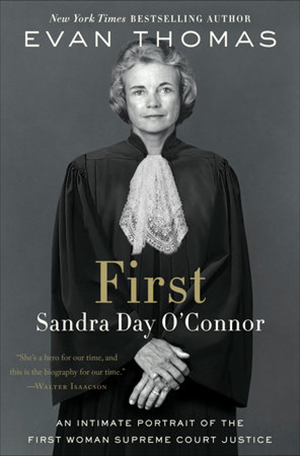
An Interesting Read: Justice Sandra Day O’Connor

From the ABA Journal:

Retired Justice Sandra Day O’Connor privately commented that her replacement was dismantling her legacy, according to a new O’Connor biography scheduled for release on March 19.

O’Connor, known as a swing justice, believed that conservative Justice Samuel A. Alito Jr. had betrayed her accomplishments, according to biographer Evan Thomas. The National Law Journal and NPR have previews of the book, First, Sandra Day O’Connor: An Intimate Portrait of the First Woman Supreme Court Justice.

O’Connor had viewed Alito as aloof and told a friend that he had no sense of humor, according to the book.

NPR calls the new book “an unvarnished and psychologically intuitive look at the nation’s first female Supreme Court justice, and some of her contradictory characteristics. She was tough, bossy, relentless and, beneath that, she could be emotional. In private, she was not afraid to cry—and she had a soft spot for others when they needed it.”

While on the court, O’Connor encouraged collegiality by trying to get more justices to show up for weekly lunches. At first, only four justices were attending. O’Connor would show up in missing justices’ chambers and sit there until they came with her, the biographer told NPR.

O’Connor persevered when Justice Clarence Thomas joined the court in 1991 after a difficult confirmation battle. Justice Thomas at first turned down her invitations to the weekly lunch, but he eventually joined the group.

“A little simple thing, but he joined the group because he realized that life has got to go on, this group has got to get along,” Evan Thomas told NPR. “She made him realize that.”

The book also reveals O’Connor’s role in the Bush v. Gore decision halting a Florida recount in the 2000 presidential election. The court’s decision paved the way for George W. Bush to become president.

O’Connor persuaded Justice Anthony M. Kennedy to join her reasoning that put an end to the recount, according to the National Law Journal’s preview of the book. Kennedy wrote the per curiam decision but O’Connor wrote the phrase that the ruling was “limited to present circumstances.”

O’Connor retired from the court in 2006 with the goal of helping her husband, who had Alzheimer’s disease. She revealed in October that she also has the beginning stages of dementia that is probably Alzheimer’s. Her brother Alan had said her greatest fear was that she would get the disease, according to the biography.


Should The American Judges Association Reach Out To Immigration Judges?

The American Judges Association is a unique professional association for judges. Perhaps the time has come for us to reach out to the immigration judges and invite them to join. They are a beleaguered group of judges who could use our support.  The American Bar Association says the nation’s immigration courts are on the “brink of collapse” due to the high volume of cases. See CNN. Also on the brink of collapse in many jurisdictions is the volunteer network helping migrant families like the ones now in Arizona. See AZ Mirror.


Constitutional Rights Of The Homeless

A federal appeals court earlier this week confirmed that the homeless cannot be prohibited arbitrarily from sleeping outside by sweeping city ordinances designed to clear out public property. The 9th U.S. Circuit Court ruling applies to all Western states in its jurisdiction, including Washington, where there has been a bitter battle in Seattle over what to do with sprawling homeless encampments. View the opinion here.

Can US Judges Learn From The Experience In Canada?

Colton Fehr (University of Alberta – University of Alberta, Faculty of Law, Students) has posted Infusing Reconciliation into the Sentencing Process ((2019) 28:2 Constitutional Forum 25) on SSRN. Here is the abstract:

The Canadian criminal justice system has long been criticized for its over-incarceration of First Nations peoples. In response, Parliament required that courts consider the unique circumstances impacting First Nations persons before passing sentence, and in particular before imposing a sentence of imprisonment. Although these efforts are important for reconciling relations between First Nations people and Canada, scholars have paid inadequate attention to whether the process in which the vast majority of sentencing hearings are conducted might also hinder reconciliation. In this article, I contend that the traditional order of sentencing submissions will generally fail to facilitate important dialogue between state representatives and First Nations people. I propose that reversing the order in which counsel make sentencing submissions would allow for a dialogical approach to sentencing that would better ensure that First Nations offenders feel they are treated fairly by the criminal justice system

Should Courts Promote The Ability To Get An Expungement?

J.J. Prescott and Sonja B. Starr (University of Michigan Law School and University of Michigan Law School) have posted Expungement of Criminal Convictions: An Empirical Study on SSRN. Here is the abstract:

Laws permitting the expungement of criminal convictions are a key component of modern criminal justice reform efforts and have been the subject of a recent upsurge of legislative activity. This debate has been almost entirely devoid of evidence about the laws’ effects, in part because the necessary data (such as sealed records themselves) have been unavailable. We were able to obtain access to deidentified data that overcomes that problem, and we use it to carry out a comprehensive statewide study of expungement recipients and comparable non-recipients. We offer three key sets of empirical findings. First, among those legally eligible for expungement, just 6.5% obtain it within five years of eligibility. Drawing on patterns in our data as well as interviews with expungement lawyers, we point to reasons for this serious “uptake gap.” Second, those who do obtain expungement have extremely low subsequent crime rates, comparing favorably to the general population—a finding that defuses a common public-safety objection to expungement laws. Third, those who obtain expungement experience a sharp upturn in their wage and employment trajectories; on average, within two years, wages go up by 25% versus the pre-expungement trajectory, an effect mostly driven by unemployed people finding jobs and very minimally employed people finding steadier or higher-paying work.

Darn I Hope To Issue A Few Orders After I Die

In JIM YOVINO, FRESNO COUNTY SUPERINTENDENT OF SCHOOLS v. AILEEN RIZO, No. 18-72, February 25, 2019 (U.S.S.C),

A judge on the United States Court of Appeals for the Ninth Circuit, the Honorable Stephen Reinhardt, died on March 29, 2018, but the Ninth Circuit counted his vote in cases decided after that date.

The Supreme Court of the United States noted that in “the present case, Judge Reinhardt was listed as the author of an en banc decision issued on April 9, 2018, 11 days after he passed away. By counting Judge Reinhardt’s vote, the court deemed Judge Reinhardt’s opinion to be a majority opinion, which means that it constitutes a precedent that all future Ninth Cir­cuit panels must follow”.

The Unites States Supreme Court concluded that “federal judge” are appointed for “life, not for eternity”:

Because Judge Reinhardt was no longer a judge at the time when the en banc decision in this case was filed, the Ninth Circuit erred in counting him as a member of the majority. That practice effectively allowed a deceased judge to exercise the judicial power of the United States after his death. But federal judges are appointed for life, not for eternity.

We therefore grant the petition for certiorari, vacate the judgment of the United States Court of Appeals for the Ninth Circuit, and remand the case for further proceed­ings consistent with this opinion.

Be Careful About Your Guilty Pleas

Myeonki Kim (Korean National Police University) has posted Conviction Beyond a Reasonable Suspicion? The Need for Strengthening the Factual Basis Requirement in Guilty Pleas (Concordia Law Review 3(1), 2018) on SSRN. Here is the abstract:

Does the court, before accepting a guilty plea, check the accuracy of the plea agreement in any significant way? This article addresses the issues on judges being unconcerned or the inconsistent practice of guiding the stages of guilty plea. The article further suggests that the judge should carefully review its factual basis to avoid a wrongful guilty plea. Although Rule 11(b) of the Federal Rule of Criminal Procedure requires the judges to check the factual basis of the guilty plea, the rule is not paid much attention to legal professionals. Setting the adversarial culture aside, the rule itself has a structural problem not to be enforced properly during a plea colloquy. Instead of revising the rule, this article proposes a newer interpretation to induce judges more responsible to confirm the factual basis. This could be a practical solution 1) to filter out an inaccurate pleading guilty, 2) to increase the accountability of the prosecution in guilty plea, and 3) to help the defendant make more informed plea decisions.

A Solution For Helping Those Without Lawyers?

The Minnesota Supreme Court has established an implementation committee for a new pilot that will permit legal paraprofessionals to provide legal advice, and in some cases, represent a client in court when under the supervision of a Minnesota attorney. The Legal Paraprofessional Pilot Project is intended to increase access to civil legal representation in case types where one or both parties typically appear without legal representation. This pilot is an outgrowth of the recommendations made by the 2017 Minnesota State Bar Association’s Alternative Legal Models Task Force.

The project will be co-chaired by Minnesota Supreme Court Associate Justice Paul C. Thissen and Minnesota Court of Appeals Judge John R. Rodenberg. The implementation committee of the pilot includes legal experts from throughout Minnesota and will produce recommendations for implementing and evaluating the pilot by February 28, 2020. Other states have studied this issue and implemented rules to allow for limited legal representation by paraprofessionals.


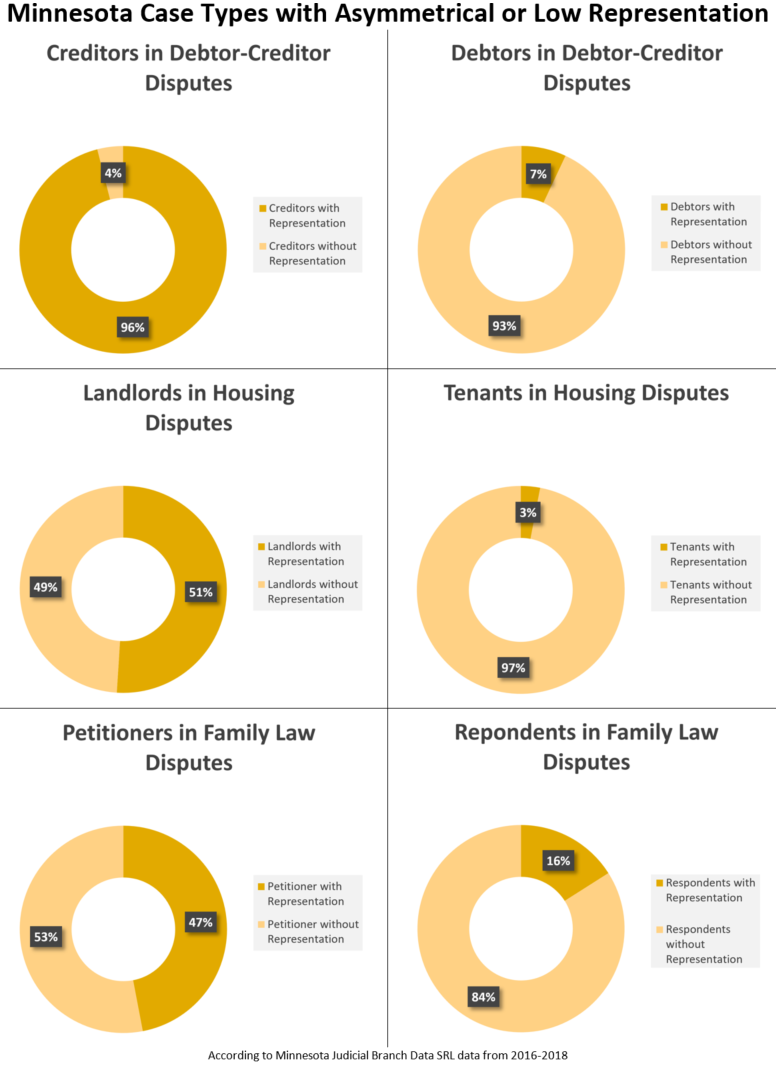
The scope of the Legal Paraprofessional Pilot Project will be limited to one of three areas of unmet need in civil law—housing disputes, family law, and creditor-debtor disputes. These three civil case types have a high frequency of asymmetrical representation or low overall representation. Minnesota courts data shows that in creditor-debtor cases 96 percent of creditors have representation and seven percent of debtors have representation. Housing disputes see similarly unbalanced but also low rates of representation with 51 percent of landlords represented and three percent of tenants represented. In family law cases, the majority of parties are unrepresented.

“Our data shows unmet need for legal representation in our courts,” said Minnesota Supreme Court Chief Justice Lorie S. Gildea. “The Legal Paraprofessionals Pilot Project is an opportunity to help lower income Minnesotans get the legal representation they may need, but often cannot afford, in civil matters. I’m pleased Justice Thissen and Judge Rodenberg have agreed to lead the committee to study this pilot’s implementation.”

See Minnesota Supreme Court Order ADM19-8002 for further information.

Who Cares What The Law Is In Delaware…….Maybe We Can Learn About It

Like its federal counterpart, Delaware Rule of Evidence 106 provides that

If a party introduces all or part of a writing or recorded statement, an adverse party may require the introduction, at that time, of any other part — or any other writing or recorded statement — that in fairness ought to be considered at the same time.

There’s a split among states as to whether this “rule of completeness” is simply a rule of timing or also a rule of admissibility. In other words, does it merely regulate when otherwise admissible evidence can be admitted or can it be used to transform otherwise inadmissible evidence into admissible evidence.

As the recent opinion of the Supreme Court of Delaware in Thompson v. State, 2019 WL 845674 (De. 2019), makes clear, Delaware’s rule of completeness is a rule of admissibility.

In Thompson, Aaron Thompson was charged with murder and related crimes, and Joshua Bey testified against him as a witness for the prosecution. Thereafter,

[o]n cross-examination, Thompson confronted Bey with several statements from his prior statements to the police that were inconsistent with his testimony at trial. A substantial portion of Bey’s cross-examination involved Thompson’s counsel confronting Bey with several statements he made in the August 14 proffer that were inconsistent with his trial testimony. He also questioned Bey about two discrete points in the September 5 statement that were inconsistent with his trial testimony.

Subsequently, the prosecution successfully argued that the entirety of Bey’s September 5th statement was admissible as a prior consistent statement under Delaware Rule of Evidence 801(d)(1)(B).

After he was convicted, Thompson appealed, claiming that the September 5th statement was not admissible as a prior consistent statement. The Supreme Court of Delaware rejected this argument, concluding that

Where, as here, the cross-examiner’s goal is to impeach the credibility of the testifying witness by arguing that the witness’s whole story is made up and does this by bringing up isolated examples of inconsistencies with a prior statement that are insignificant to the whole story, it is appropriate under Rule 106 for the jury to hear the entire prior statement to properly assess the witness’s credibility. Thompson’s line of attack was that since Bey could not keep his story straight (or consistent), he must have made the whole thing up. The recorded statement, however, was largely consistent with Bey’s trial testimony. Therefore, playing the entire statement countered Thompson’s argument that Bey was making everything up.

Finally, the court concluded that “[s]ince we find that Bey’s September 5 statement was admissible under Rule 106, we need not consider its admissibility under Rule 801(d)(1)(B).”

Therefore, Delaware Rule of Evidence 106 clearly allows for the admissibility of evidence that is not admissible under any other rule of evidence.

Collateral Consequences Resource Center Study

CCRC is pleased to announce that we are undertaking a major study of the public availability and use of non-conviction records – including arrests that are never charged, charges that are dismissed, deferred dispositions, and acquittals.   Law enforcement agencies and courts frequently make these records available to the public through background checks, and allow their widespread dissemination on the internet.  This can lead to significant discrimination against people who have not been judged guilty of any wrong-doing, and result unfairly in barriers to employment, housing, education, and many other opportunities.  While almost every U.S. jurisdiction makes some provision for limiting public access to non-conviction records through mechanisms like sealing or expungement, such relief provisions vary widely in availability and effect, and are often hard to take advantage of without a lawyer.  What’s more, arrest records may remain accessible on the internet long after official files have been made confidential or even destroyed.  While CCRC’s Restoration of Rights Project now includes state-by-state information on how non-conviction records may be sealed or expunged, our new project will examine applicable laws more closely.

The first phase of this project, which is nearing completion, will produce a detailed inventory of the laws in each U.S. jurisdiction for limiting public access to arrests and/or judicial proceedings that do not result in conviction.  Among other things, this inventory will examine eligibility criteria, procedures (including any filing fees), and scope of relief.  We will also note where state law or court rulings permit sealing of dismissed charges where one or more charges in a case do result in conviction.  In a second phase of this project, we will consult with policy experts to conduct a nationwide analysis, examining specific issues across all jurisdictions, identifying patterns and gaps in existing policies.  The goal of a third phase will be to produce model legislation.

To mark the launch of our project on non-conviction records, we are pleased to publish the following op-ed, prepared for CCRC by Professors Jordan M. Hyatt and Sarah E. Lageson, which calls on legislators, law enforcement, and scholars to address the damage caused by bulk publication on the internet of pre-conviction information such as booking information and mugshots. 

It’s Time to Address the Damage of a ‘Criminal’ Digital Reputation

By Jordan M. Hyatt and Sarah E. Lageson  

Kill this secret arrest bill,” advocated a recent editorial in an upstate New York newspaper.  “Mugshot proposal pits privacy versus the right to know,” claimed another. These articles and op-eds were in clear opposition to NY Governor Andrew Cuomo’s recent proposal to halt the routine release of criminal mug shots unless there is a compelling law enforcement reason to do so. In his 2020 executive budget, the governor overtly recommends broad limitations on the unregulated release of potentially damaging pictures and information gathered during the arrest and pre-conviction processes.

The rationale for ending bulk disclosure of criminal record data lies in the harms presented by relatively unfettered access to all forms of criminal “records” on the internet. The current levels of availability have led to massive extortion and blackmail schemes, and leave mugshot subjects with enduring “digital punishment.” In Cuomo’s view, the only way to prevent such abuses of criminal justice data is to prevent the release in the first place. If his measure gains support, the public release of booking information and mugshots would no longer be permitted in New York, as their distribution would be considered “an unwarranted invasion of personal privacy.”  Many advocates agree that this reform would directly benefit individuals currently impacted and stigmatized by these policies.

New York is not the first state to grapple with the question of mugshots and arrest records. Several states, including California and Pennsylvania, have taken affirmative action against the release of mugshots through criminal charges and class action lawsuits. Dozens of states have passed laws banning mugshot extortion schemes, which monetize these harms by charging takedown fees to people who request that their photo be removed.

Limiting public access to mugshots, arrest records, and other pre-conviction records means recognizing that those records are part of the sources of collateral consequences. A criminal digital reputation can fuel stigmatization and negatively impact individuals for much longer than they ever spent behind bars — especially if charges were later dismissed or an arrest was expunged or sealed. Having a universally accessible criminal record – even for an arrest – also means being permanently labeled on the internet as an “offender,” presenting a host of collateral consequences. Research has established that opportunities for employment, housing and governmental services are sharply curtailed, social and familial relationships are strained, and reputations are often irreparably damaged.  These conclusions have been drawn by stakeholders across the ideological spectrum, from the ACLU to the Heritage Foundation.

For scholars, it might be time to consider the ways that digital access has expanded the scope of the traditionally recognized collateral consequences. Today, criminal records are much more than the official court file. A shadowy industry has worked to expand this definition. These images and records, frequently indexed by search engines, are more visible, harder to correct and more likely to trigger collateral consequences than any court record. The accompanying information is often incomplete or inaccurate. Not only does this line the pockets of the website’s owners, it disproportionately impacts the poorest citizens.

While many reforms are progressive, they are not without precedent.  There is currently a legal justification for making some, but not all, criminal history data publicly available for reasons of public safety, including through sex offender registries.  These are the reasoned actions of the state and an elected government.  But, in this digital world, meaningful rehabilitation requires a more nuanced approach – one that prevents the damage inflicted from the publication of a dismissed charge and that protects people’s ability to move on from an outdated conviction.  Any solution must protect arrestees from extortion while preserving law enforcement’s ability to do their job.

Legislators and law enforcement must take action at the federal, state and local levels.  And as Governor Cuomo has suggested, the conversation must begin by openly reconsidering the scope of publicly available mugshots and arrest data.  Authorities should start treating these records as truly sensitive information and consider if these data should be released and, if they are, what usages are acceptable.

At a minimum, the rights of potentially-innocent arrestees should be protected by limiting access to booking photos at least until after a preliminary hearing in front of a judge.  Systems must be put in place to ensure that the criminal records that are released are accurate and complete.  The industry of mugshot extortion must be legislated out of existence.

Progressive statutory and enforcement reform may be necessary to facilitate this change. Failing to check the usage of illicit mugshots for fiscal gain undermines confidence in law enforcement, the courts and ongoing efforts to undo the harms of a criminal justice system with a documented history of inequity and disparate treatment.

Jordan M. Hyatt is an Assistant Professor in the Department of Criminology and Justice Studies, Drexel University (Philadelphia, PA).

Sarah E. Lageson is an Assistant Professor in the School of Criminal Justice, Rutgers University (Newark, NJ).